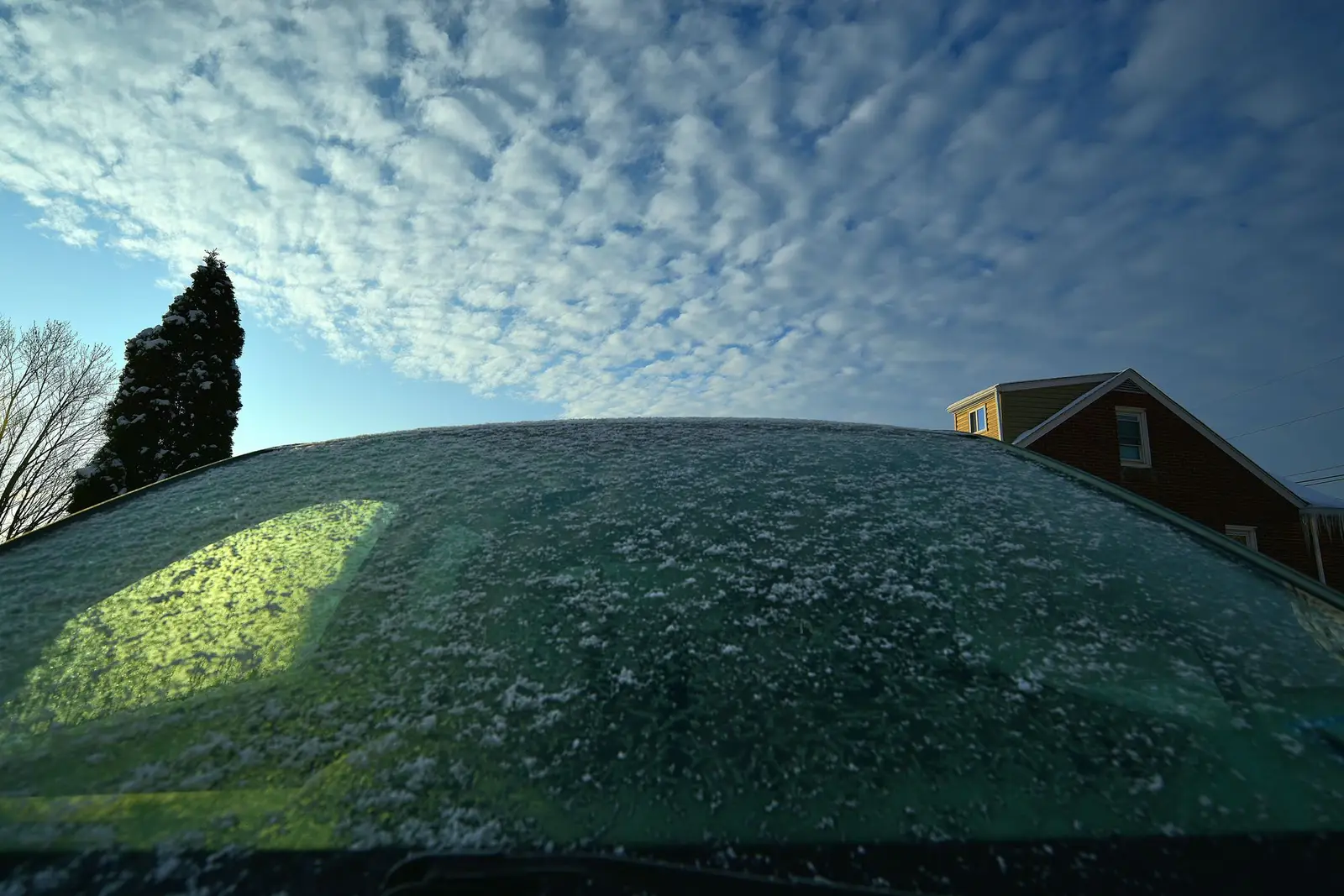
Yes, windshield washer fluid freezes. Summer and bug remover fluid is often rated only to 32°F, the same as water. Rain-X Bug Remover, for one, is labeled "Effective to 32°." Winter de-icer fluid is rated far lower, for example -25°F for Rain-X Heavy Duty De-Icer and -30°F for Splash De-Icer.
When winter fluid freezes on a 15°F South Jersey night, look at what else is in the tank. Christian Brothers Automotive calls summer fluid and fluid diluted with water the most common cause of frozen washer fluid (CBAC). Splash, a washer fluid maker, says as little as 10 ounces of fluid without freeze protection in the reservoir can raise the freezing point (Splash FAQ).
If nothing sprays right now: stop pressing the switch, thaw it slowly, then refill with undiluted winter fluid.
What to Do Right Now
- Stop pressing the washer switch. A parts retailer's guide warns that repeated tries against frozen fluid can overload the pump circuit and blow a fuse (Aero Auto Parts).
- Clear the glass another way. Run the defroster and use a scraper. Do not pour hot water on a cold windshield. AutoZone warns that the rapid expansion can crack the glass (AutoZone).
- Thaw it slowly. Splash's advice is to park in a warm garage until the fluid thaws. Keep the engine off indoors. NHTSA warns against running a car for long periods in an enclosed space (NHTSA).
- No garage? Drive, use the sun, keep any warm-up short. CarParts.com's guide, reviewed by an ASE master technician, lists driving around, parking in a sunny spot and warming up your vehicle as ways to melt it (CarParts.com). In New Jersey, a gasoline car that is not moving may not idle more than three consecutive minutes (N.J.A.C. 7:27-15.8). The rule's exceptions, such as stop-and-go traffic and repairs, do not include warming a parked car.
- Replace what froze. Once it is liquid, the old fluid is the problem. Splash suggests emptying the reservoir completely between seasons, so nothing dilutes the new fluid. Do not empty it by holding the switch until the tank runs dry. Aero Auto Parts says running an empty washer system can overheat the pump.
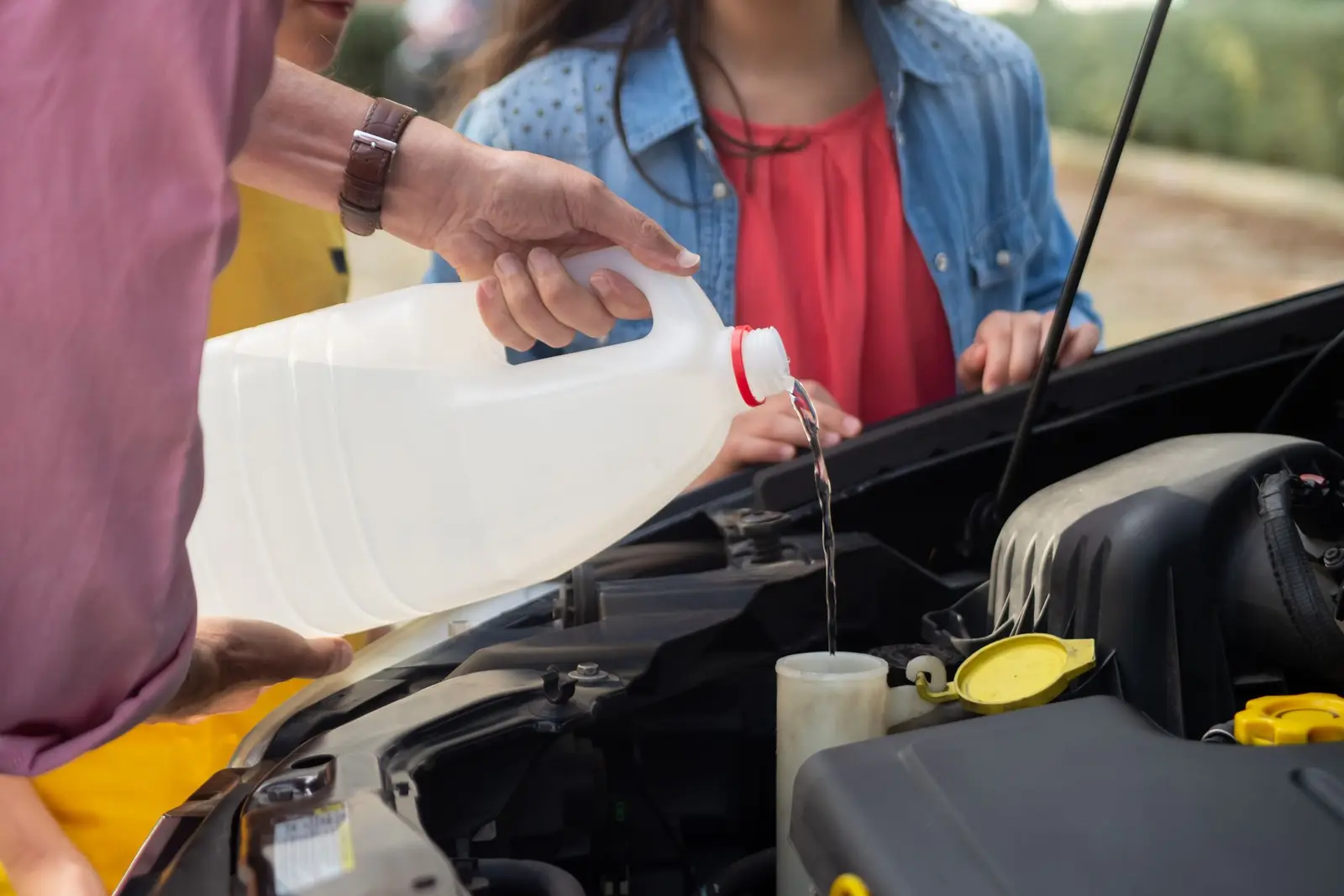
- Refill without adding water. Ready-to-use winter fluid goes in as it is; Rain-X's directions for its de-icer say to fill the reservoir "without diluting product" (Rain-X). Then test with a short press.
Which Washer Fluids Freeze, and at What Temperature
Read the temperature on the label, not the color. Aero Auto Parts says formulas vary widely in how much frost protection they give.
| What is in the tank | Rated to, or what happens |
|---|---|
| Rain-X Bug Remover (a summer fluid) | 32°F. Labeled "Effective to 32°" (Rain-X). |
| Plain water | 32°F. Added to winter fluid, it raises the mix's freezing point (CBAC). |
| Rain-X Heavy Duty De-Icer or Rain-X 2-in-1 | -25°F, per Rain-X's product pages (De-Icer, 2-in-1). |
| Splash De-Icer | -30°F, per Splash (Splash FAQ). |
| Winter fluid in general | -20°F to -40°F, depending on ingredients. Windshield washer antifreeze stays liquid to -50°F (CarParts.com). |
| Engine coolant (antifreeze) | Do not use it. Honda's manual says it can damage your paint (Honda owner's manual). |
| Vinegar and water | Do not use it. The same Honda manual says it can damage the washer pump. |
Some guides online suggest vinegar or homemade mixes. Your owner's manual has the final word. Honda's says: "Use only commercially available windshield washer fluid."
How Cold It Gets Around Audubon, and What Rating You Need
NOAA's 1991-2020 climate normals for Philadelphia International Airport, across the Delaware River from South Jersey, show a normal winter:
- December to February: 59.2 nights at or below 32°F.
- Colder nights: 14.3 at or below 20°F, and 2.2 at or below 10°F.
- Below zero: 0.0 nights at or below 0°F.
- November: 5.4 nights at or below 32°F, the rating of a summer fluid like Rain-X Bug Remover.
Source: NOAA NCEI U.S. Climate Normals, station USW00013739.
Last winter ran colder than those normals. NOAA's daily records for the same airport, December 1, 2025 to February 28, 2026, show:
- 76 of 90 nights at or below 32°F.
- 22 nights at or below 20°F, and 12 at or below 15°F.
- 3 nights at or below 10°F.
- The coldest: 8°F on February 8, 2026. The low was 10°F the day before.
Source: daily data for Philadelphia International Airport from NOAA's Regional Climate Centers (ACIS).
On the evening of February 7, a New Jersey Reddit thread asked, "Anyone's windshield washer fluid freeze today?" (r/newjersey). One driver without sub-zero fluid said theirs froze "anytime it's below 20." Another said it froze every day "that's below 15 degrees."
What this means for your tank: an undiluted bottle rated to -20°F had 28 degrees to spare on last winter's coldest night at the airport. When washer fluid freezes in Camden County, check what else is in the tank first.
Pump Hums or Stays Silent: What It Tells You After a Thaw
Once the system has fully thawed, press the switch once and listen.
| What happens | Likely cause, then next step |
|---|---|
| Pump hums, nothing sprays | Ice still in a hose or nozzle, a blocked nozzle, a restricted hose or a disconnected fitting. Give it more time. If a full thaw changes nothing, have the hoses and nozzles checked. |
| No sound at all | A fuse, the switch, the wiring or the pump. Have the circuit tested before any part is replaced. |
| One nozzle sprays, the other doesn't | Ice in that nozzle. Give it more time to thaw before anything else. |
| The fluid level drops, or there is a puddle | A cracked reservoir or a leaking hose. YourMechanic says freezing can crack the reservoir, and a cracked one can't be repaired, only replaced (YourMechanic). |
| It sprays, then ices over on the glass | Fluid that freezes on contact. CarParts.com warns this limits your vision. Stop spraying and use the defroster. |
The first two rows and the leak row follow Aero Auto Parts' guide. The nozzle row follows Texas Reliable Auto Glass. Treat the table as a starting point. A circuit test settles it.
RepairPal describes how a shop narrows it down. The fuses are checked first, then power at the washer switch, then power from the switch to the pump. A pump that gets power and still won't run is bench-tested and confirmed failed (RepairPal).
What a Frozen Washer System Can Cost
- A fuse: AutoBlast's electrical systems page lists fuse and relay diagnosis and replacement at $80 to $200.
- A washer pump: RepairPal's national estimate is $181 to $259. That is $116 to $171 in labor and $64 to $88 in parts. RepairPal updated it September 3, 2026, and says it leaves out taxes, fees and your location.
- A cracked reservoir: replaced, not repaired, per YourMechanic. The price depends on the car.
RepairPal notes that a technician will usually charge to test the system first. It says that protects you from replacing a pump that still works.
What Not to Put in a Frozen Washer Tank
- Engine antifreeze. Honda's manual says it can damage your paint.
- Vinegar and water. The same manual says it can damage the washer pump.
- Hot water on the glass. AutoZone warns it can crack the windshield.
- More water. It raises the freezing point of whatever winter fluid is left.
Store Washer Fluid Safely
Poison Control says windshield washer fluid contains methanol. Fluid poured straight into the tank typically contains 30% to 50% methanol, and concentrates as much as 90% to 100%. If swallowed, methanol can cause blindness and death (Poison Control).
- Keep it in its original container. Never pour it into a cup or bottle.
- Lock it away from children and pets.
- Lock a spare jug in the trunk if you carry one in winter.
- If someone swallows it, call Poison Control at 1-800-222-1222.
New Jersey Still Expects a Clear Windshield
A dead washer does not change New Jersey law. Drivers must make all reasonable efforts to remove ice and snow from the car's exposed surfaces, including the hood, trunk, windshield, windows and roof, before driving (N.J.S.A. 39:4-77.1). The law exempts a car driven during a storm that began and kept going for the whole trip, and a parked car.
- The fine: $25 to $75 per offense, even if nothing flies off.
- If ice or snow hits another vehicle or a pedestrian: $200 to $1,000 for a non-commercial driver when it causes injury or property damage.
The state's Division of Highway Traffic Safety card gives the same fines. Scrape and defrost before you pull out, then deal with the washers.
How to Keep It From Freezing Again
- Switch before the first freeze. The airport averages 5.4 freezing nights in November and 17.2 in December (NOAA normals, above).
- Empty the summer fluid first. Ten ounces of it can raise the freezing point of a tank of winter fluid (Splash).
- Pour winter fluid straight. Don't top it off with water. A concentrate is the exception: mix it only as its label says.
- Buy by the number. An undiluted -20°F bottle covered every night of last winter at the airport.
- Chipped glass? Our glass repair page covers chip repair, and the windshield replacement cost guide covers replacement.
Getting It Checked in Audubon
AutoBlast is at 21 S. White Horse Pike in Audubon. Call (856) 546-8880.
If the washers stay dead after a full thaw, we check the fuse, the relay and the wiring before recommending parts. Our fluid services page covers the other fluids that matter in a New Jersey winter.
If the cold also left your car hard to start, see our car won't start in the cold guide.
Common Questions
At what temperature does windshield washer fluid freeze?
It depends on the fluid. Rain-X Bug Remover is rated to 32°F. Winter de-icers are rated lower, for example -25°F (Rain-X Heavy Duty De-Icer) or -30°F (Splash De-Icer). CarParts.com puts winter fluid in general at -20°F to -40°F.
Why did my winter washer fluid freeze when it wasn't that cold?
Something likely diluted it. Splash says as little as 10 ounces of fluid without freeze protection can raise the freezing point. Summer fluid left from fall and water added to stretch a jug are the usual culprits, per CBAC.
Can I put antifreeze in my windshield washer fluid?
No. Honda's owner's manual for the 2025 Accord says engine antifreeze can damage your paint. Use washer fluid rated for the cold instead.
Can I add rubbing alcohol to thaw it?
Some drivers do; it came up in the New Jersey Reddit thread above. Honda's manual says to use only commercially available windshield washer fluid. Follow your own owner's manual.
Will frozen washer fluid damage my car?
It can. YourMechanic says freezing can crack the reservoir or damage the pump. Pressing the switch against ice can also blow the fuse, per Aero Auto Parts.
Is it safe to drive with frozen washer fluid?
AutoZone says that if the fluid freezes, you can't clear the glass properly and it isn't safe to drive. New Jersey also requires you to clear ice and snow from the windshield before driving.
Need Help With Your Vehicle?
AutoBlast is Camden County's trusted auto repair and body shop. Send the page you are reading with your vehicle details, or call the shop for faster help.