Undercoating & Rust Proofing in Audubon, NJ
The short answer: a newer car you will trade in before its warranty runs out usually does not need undercoating, because factory corrosion protection covers those years. A car you are keeping well past the warranty, a pickup or body-on-frame SUV, or anything that already shows surface rust underneath is where it pays: an oil- or wax-based rust proofing applied in October or November, before the first brine, and renewed every year. Rubberized undercoating belongs only on clean, sound metal. Whatever you choose, have the underside looked at on a lift first, because no coating fixes rust that is already eating through.
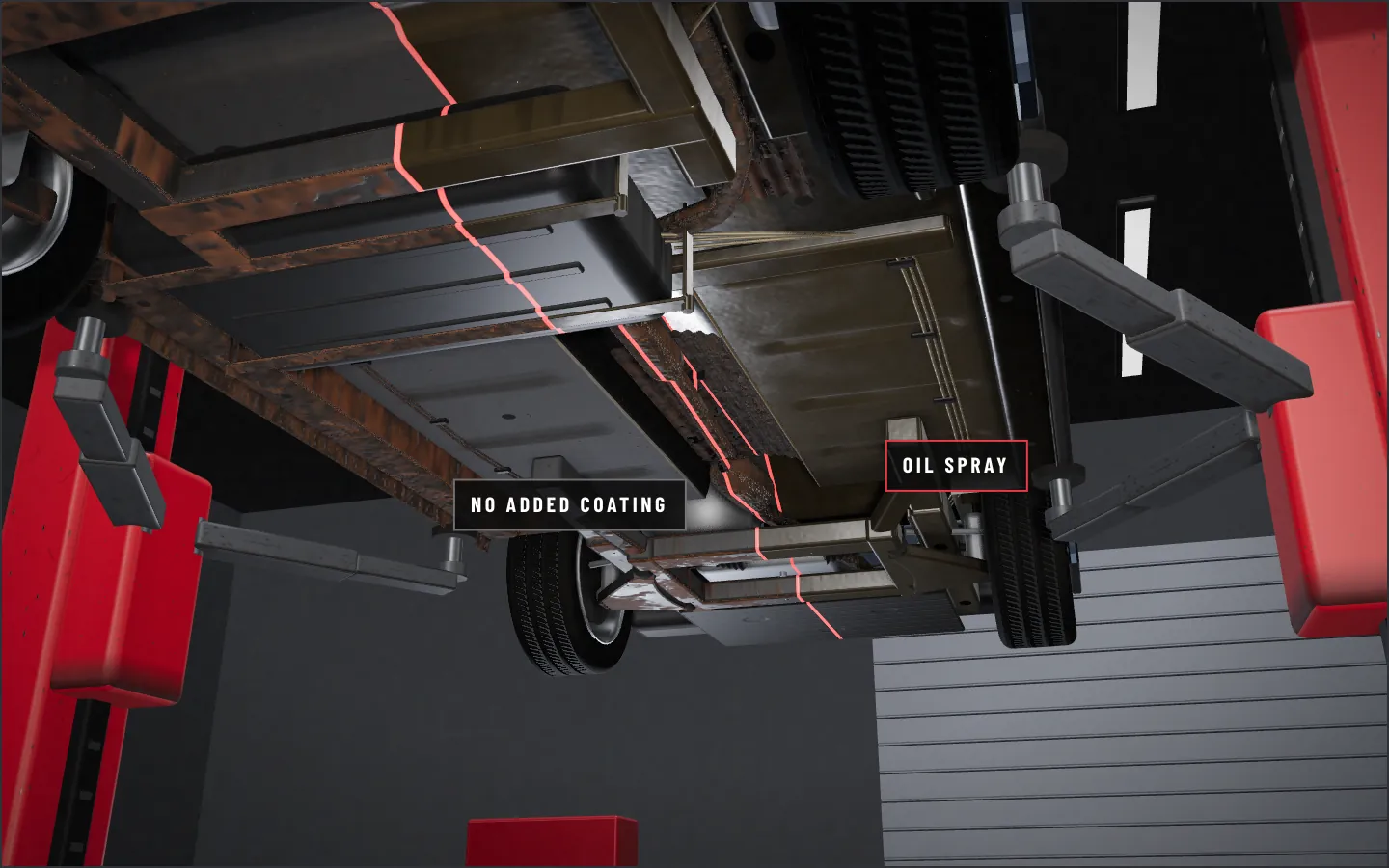
The reason it matters here: every winter the underside of your car drives through the same brine the state sprays on the road. It hangs in the seams, pinch welds, frame rails and brake lines long after the snow is gone, and that is where South Jersey rust starts, underneath, years before it shows on a door or a fender. The simulator below shows how salt works on an underbody over a run of New Jersey winters, with and without a coating.
Interactive
Watch New Jersey Salt Work on an Underbody
Drag the slider to add winters and watch where rust starts: seams, pinch welds and brake lines first, flat panels last. Pick a coating to see what it protects and what it cannot reach, press Play to run one winter of brine spray and a spring rinse, or Compare to see an untreated side next to a coated one on the same car.
 Loading 3D view
An illustration of how road salt corrodes an underbody, not a prediction for your car. The real answer comes from putting your car on the lift.
After 8 New Jersey winters with factory protection only: worst is exhaust pipe and hangers surface rust; brake lines surface rust.
Part by part
- Exhaust pipe and hangerssurface rust
- Brake linessurface rust
- Rocker panels and pinch weldssurface rust
- Fuel-tank strapssurface rust
- Inner wheel wellssurface rust
- Lower control armssurface rust
- Rear subframesurface rust
- Fuel linesclean
- Frame railsclean
- Floor panclean
Want to know what is actually under your car? We put it on the lift in Audubon and show you before anything gets sprayed.
How New Jersey Road Salt Gets Under Your Car
NJDOT does not only spread dry rock salt. Its own winter FAQ says the rock salt is wetted with liquid calcium chloride or a salt brine blend to make it melt faster, and that the department pre-treats thousands of lane miles with brine before a storm starts. It can store up to 228,000 tons of salt at 68 facilities and just over 1,000,000 gallons of anti-icing liquid. County and town crews treat their own roads on top of that.
The liquid part is what matters for your car. AAA found that brines and liquid de-icers stay liquid longer than dry salt, coat components and seep into cracks and crevices where corrosion speeds up. In AAA's survey, U.S. drivers paid an estimated $15.4 billion in rust repairs caused by de-icing over five years, about $3 billion a year and almost $500 per repair.
The parts that take it first are the ones closest to the tire spray and the ones that hold moisture:
- Brake lines and fuel lines. Thin steel tubes clipped along the frame or floor. When NHTSA investigated brake-line corrosion on six million 1999-2003 GM pickups and SUVs, 85 percent of the complaints came from salt states, New Jersey among them, at 43.0 complaints per 100,000 vehicles against 3.0 elsewhere. Its 2015 advisory tells owners to wash the undercarriage often during the winter and clean it after winter, check the brake pipes, and replace the brake pipe assembly if severe corrosion is present.
- Rocker panels and pinch-weld seams. Two layers of metal pressed together, a natural trap for brine.
- Frame rails and subframes. Especially on pickups and body-on-frame SUVs, where the frame is exposed and boxed sections hold water inside.
- Fuel tank straps, exhaust hangers and suspension arms. Small parts with a big job; when they rust through, the part they hold comes loose.
- Inner wheel wells and body drain holes. The drain holes let water out of doors and rockers. Blocked holes keep brine inside the panel.
Undercoating vs. Rust Proofing: The Three Types
People use the words interchangeably. What matters is what is actually sprayed, because the three kinds of product behave very differently on a salt-belt car.
Oil- and lanolin-based sprays
Thin, soft coatings sprayed onto the underbody and into seams and cavities. Fluid Film is lanolin-based; Krown is an oil-based rust inhibitor. Because they stay wet, they creep into pinch welds and into rust that has already started, and they do not trap moisture behind a hard shell. The trade-off is life: they wash and wear off, most of all where the tires throw spray. Krown's own FAQ says an annual application provides 12 months of protection, and yearly reapplication is the norm for this kind of product. Expect some dripping and a light smell for the first days.
Wax-based coatings
A thicker film than an oil spray that firms up after it is applied. It stays on longer between applications in most spots and still creeps into seams better than a hard coating, but it wears in the areas that take the most tire spray, so those areas need a touch-up when the underside is checked.
Rubberized undercoating
The black, thick coating most people picture. On clean, dry, sound metal it is a durable barrier against stone chips and salt, and it deadens road noise. The risk is what goes under it. KBS Coatings, which makes coatings, puts it plainly: rubberized undercoating traps rust under one condition, when it is sprayed over metal that is not clean, dry and already sealed. Sprayed over existing rust or moisture, it seals the problem in and hides it, and if it covers the drain holes it keeps water in the panels. That is why rubberized coating belongs on new or fully prepared metal, and why we do not spray it over a frame that is already scaling.
Does Your Car Actually Need Undercoating?
The honest answer depends on the car, and a shop that does undercoating should tell you when you do not need it. Consumer Reports' short answer for new cars is no: cars are built with corrosion protection today, and it advises buyers to skip undercoating as a dealer add-on, which it put at about $800.
Where it earns its money in South Jersey:
- You are keeping the car well past its warranty. Factory protection ages, and every winter adds up. The years that count are years five through fifteen.
- Pickup trucks and body-on-frame SUVs. An exposed ladder frame and boxed rails catch salt that a unibody car sheds.
- A car with early surface rust you want to slow down. An oil or wax product that creeps into the rust is the right tool here, not a rubberized shell.
- A used car that spent its life in a salt state. Get the underside looked at before you decide what it needs.
Where to skip it or do something else first:
- A new car you will trade in before the warranty runs out. The factory protection covers the years you will own it.
- Heavy scale, flaking brake lines or rust-through. No coating reverses that. The metal needs rust repair first, and brake lines that are flaking need replacing, not coating.
When to Undercoat in South Jersey
Before the salt, not after it. The best window is October and November, on a dry day, so the product goes onto clean dry metal before the first brine run. If you missed the fall, the next best time is spring, after a thorough underbody wash that gets the winter's salt off, which is NHTSA's advice either way. Oil and lanolin sprays go back on every year; wax and rubberized coatings are checked each year and touched up where they have worn.
What an Undercoating Visit at AutoBlast Includes
It starts with the car on the lift at our Audubon shop on the White Horse Pike, so we see the whole underside instead of guessing from the driveway:
- Underside inspection. Frame rails, rockers, brake and fuel lines, tank straps, exhaust hangers, subframe mounts and drain holes.
- Honest call on existing rust. Light surface rust is noted, because the right product depends on it. Scale, flaking lines or rust-through are shown to you and quoted separately in writing as rust repair. Nothing gets coated over.
- Clean and dry. Loose scale and road dirt come off and the underside is dried, because a coating is only as good as the metal under it.
- Masking. Brakes, exhaust, sensors and anything that should stay clean are covered.
- Coating. The underbody, seams and pinch welds, and the frame and rocker cavities where the product can reach.
- Drain holes and walk-through. Drain holes are checked open, and we walk you through what we found and when the coating should be looked at again.
Every job is quoted in writing before any work starts, and if the inspection shows the car does not need a coating, we will say so. Call (856) 546-8880 to book a time before the salt season, or send us a request.
Undercoating Near Audubon, Cherry Hill and Camden County
AutoBlast is at 21 S. White Horse Pike in Audubon, a short drive from Haddon Heights, Oaklyn, Mount Ephraim, Collingswood, Bellmawr, Barrington, Haddonfield and Cherry Hill. The same shop handles the rust repair an inspection turns up, the exhaust and brake parts salt wears out, and the pre-winter detail that keeps salt off the paint.
Signs You Need Undercoating & Rust Proofing
- Orange surface rust on the frame rails, subframe or suspension arms
- Bubbling paint along the rocker panels or wheel arches
- Brake or fuel lines with rust you can see when the car is up
- Rusty exhaust hangers, heat shields or fuel tank straps
- A pickup truck or body-on-frame SUV driven through New Jersey winters
- A car you plan to keep well past its warranty
- A used car bought from another salt-belt state
What to Expect
- 01
The car goes up on the lift for a full underside inspection: frame rails, rockers, brake and fuel lines, tank straps, exhaust hangers and drain holes
- 02
We show you what we found. Light surface rust decides which product fits; scale, flaking lines or rust-through are quoted separately in writing as rust repair
- 03
Loose scale and road dirt come off and the underside is dried so the coating goes onto clean, dry metal
- 04
Brakes, exhaust, sensors and anything that should stay clean are masked
- 05
The coating goes onto the underbody, seams, pinch welds and the frame and rocker cavities it can reach
- 06
Drain holes are checked open and we walk you through the result and when to have it checked again
Frequently Asked Questions
What is the average cost to undercoat a car?
It depends on the size of the vehicle, the product and how much rust prep the underside needs. A pickup truck with a full frame takes more product and time than a compact car, and a frame with loose scale needs cleaning before anything is sprayed. Consumer Reports put a dealer undercoating add-on at about $800. At AutoBlast the price is quoted in writing after the car is on the lift, before any work starts.
Is it worth it to undercoat your car?
For a new car you will trade in within the warranty, usually not; Consumer Reports' short answer is no, because cars are built with corrosion protection. It is worth it on a car you will keep well past the warranty in South Jersey salt, on pickups and body-on-frame SUVs with exposed frames, and on cars with early surface rust you want to slow down with an oil or wax product.
How long does undercoating last?
It depends on the product. Oil- and lanolin-based sprays wear off and are reapplied every year; Krown says one application gives 12 months of protection. Wax coatings last longer between applications but wear where the tires spray hardest. Rubberized undercoating lasts longest on clean metal but should be checked every year for cracks and chips, because rust can start where it is damaged.
What is the best type of undercoating?
There is no single best one. Oil or lanolin sprays creep into seams and existing surface rust and do not trap moisture, but need yearly reapplication. Wax lasts longer between visits. Rubberized is the toughest barrier, but only on clean, dry, sound metal. For an older salt-belt car with some surface rust, a creeping oil or wax product is usually the better choice than a rubberized shell.
What are the disadvantages of undercoating?
Oil sprays drip for the first days and have to be redone every year. Rubberized coating sprayed over rust or moisture seals the problem in and hides it, and coating over drain holes keeps water inside the panels. Any coating also makes it harder to see the metal, which is why the underside should be inspected and any real rust repaired before it goes on.
Can you undercoat over rust?
Over light surface rust, an oil or wax product that creeps into the rust can slow it down. Rubberized coating should not go over rust or moisture, because it traps them. Heavy scale, flaking brake lines and rust-through need repair or replacement first; no coating fixes them.
Is undercoating the same as rust proofing?
The terms are used for the same job, but the products differ. Undercoating usually means a thicker coating on the underbody, often rubberized. Rust proofing usually means an oil, lanolin or wax product sprayed underneath and into the seams and cavities. What matters is which product goes on and whether the metal is ready for it.
What time of year should you rustproof your car in NJ?
In the fall, before the first brine and salt, on a dry day: October and November. If you missed it, do it in the spring after a thorough underbody wash that removes the winter's salt.
How do I protect my car from salt if I don't undercoat it?
Wash the undercarriage regularly through the winter and give it a thorough wash in the spring, which is NHTSA's advice for drivers in salt states. Touch up paint chips that expose bare metal, keep drain holes clear, and have the brake lines looked at when the car is up for other work.
Related Services
Rust Repair
NJ road salt rust repair and prevention — rocker panels, wheel arches, frame rails, and undercarriage corrosion fixed at the Audubon shop.
Learn More →Auto Detailing
Interior and exterior detailing, paint correction, ceramic coating, and NJ winter prep at AutoBlast in Audubon — Camden County's full-service detailer.
Learn More →Collision Repair
Full-service collision repair restoring your vehicle to pre-accident condition with precision work and full NJ insurance coordination.
Learn More →Need Undercoating & Rust Proofing? Call Us Today
Free estimates on every job. No obligation, no pressure — just honest work at a fair price.