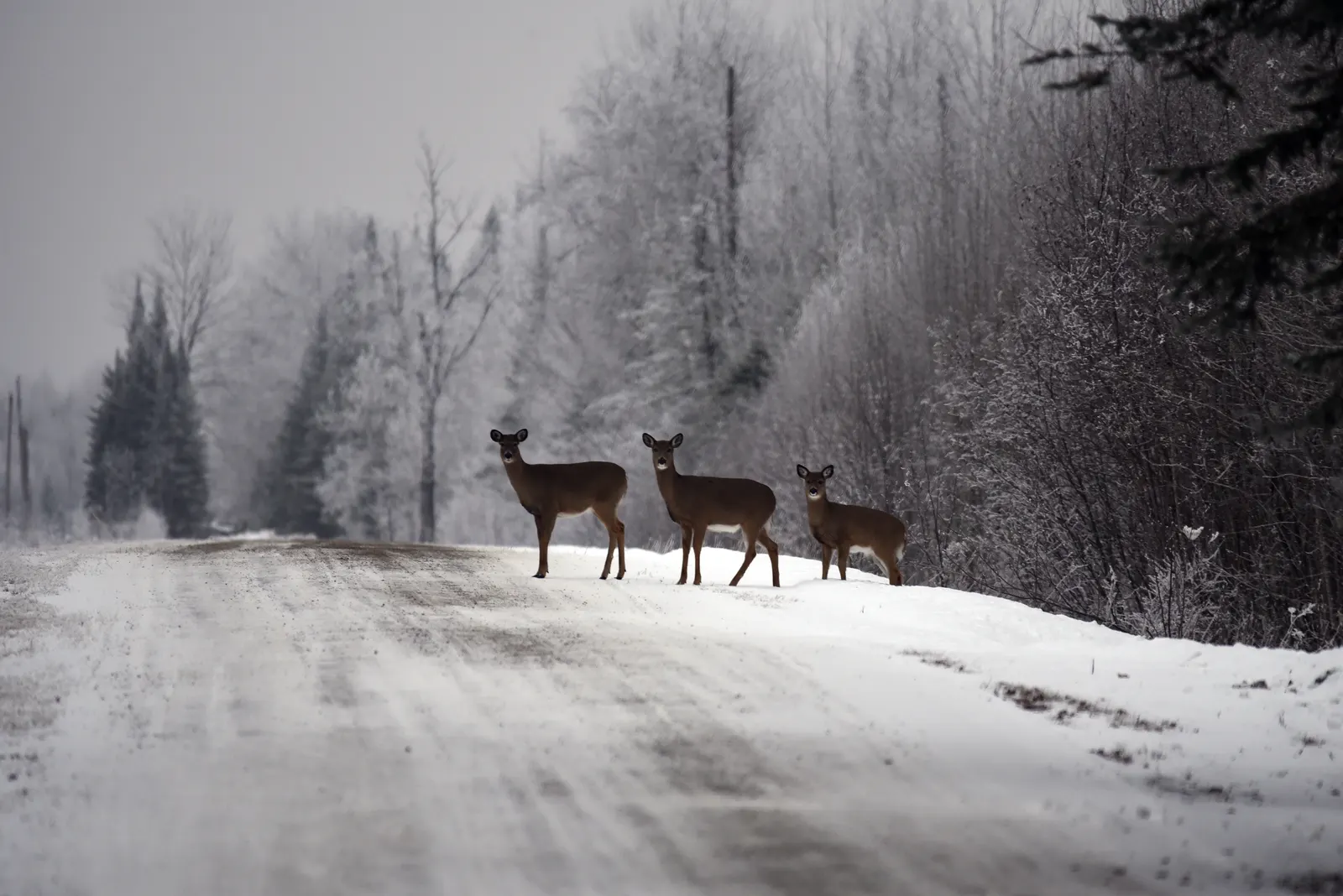
New Jersey's wildlife agency puts the peak of the deer mating season, the rut, between late October and mid-December. Bucks chase does across roads with no regard for traffic, mostly around sunrise and sunset. This year the clocks fall back at 2 a.m. on Sunday, November 1, which moves many evening commutes into the hours when deer are most active. If you drive Route 30, Route 168, I-295 or the Atlantic City Expressway in November, expect deer near the road.
This guide is written from a body shop floor in Audubon, not from an insurance company's help page. It covers the minutes after the hit, what New Jersey law actually requires, how the claim works, and the damage we find once a deer-hit front end is taken apart. If your car is already damaged, AutoBlast at 21 S. White Horse Pike handles collision repair and the insurance claim under one roof.
Quick Answer: What to Do If You Hit a Deer in New Jersey
- Brake hard and stay in your lane. Do not swerve. New Jersey's Department of Environmental Protection warns that crashes are more likely to become fatal when a driver swerves and hits oncoming traffic or a fixed object instead.
- Get to the shoulder and turn on your hazard lights. If the car will not move and you are in a travel lane, keep the hazards on and call 911.
- Leave the deer alone. An injured deer can kick hard enough to hurt you. Do not drag it off the road.
- Call the police. New Jersey requires notice to police for any crash with an injury or more than $500 of property damage, and the state wildlife agency asks drivers to report every deer collision immediately. The police report also matters for your claim and is the only way you can legally keep the deer.
- Take photos before anything moves. The front of the car from both corners, the grille close up, under the bumper, the ground under the engine, the road, and the deer from a safe distance.
- Check the car before you drive it. Look for fluid under the front, a headlight that is out or pointing the wrong way, a hood that will not latch, anything dragging, and warning lights on the dash. If you see any of those, a tow is the safer call.
- Call your insurance company. Hitting an animal is a comprehensive claim, not a collision claim, and under New Jersey's insurance eligibility points rule it is not an at-fault accident.
- Choose your own body shop. In New Jersey the shop is your choice, not the adjuster's.
How Often New Jersey Drivers Hit Deer
New Jersey is not a top-ten deer state, but the numbers are still large, and they cluster in the next ten weeks:
- 1 in 245. That is a New Jersey driver's estimated chance of an animal-collision claim in the 12 months to June 30, 2026, which ranks the state 39th of 51 (State Farm).
- 1 in 64 across the river. Pennsylvania ranks 4th in the country, and it had the most estimated animal-collision claims of any state, about 141,000. If you drive into Pennsylvania for work or weekends, you are driving in the state with the most animal-collision claims in the country.
- More than 1.6 million animal-collision claims nationwide between July 1, 2025 and June 30, 2026, with national odds of 1 in 145. Deer are the animal hit most often.
- $1.9 billion paid by State Farm alone on animal-collision claims in that same year.
- November, October and December are the three months drivers are most likely to hit a large animal, in that order.
- 210 people died in U.S. crashes involving animals in 2024, according to the Insurance Institute for Highway Safety, as reported by State Farm.
Sources: State Farm, How likely are you to have an animal collision? (September 15, 2026); State Farm newsroom, 20 Years of Animal Collision Data (September 15, 2026); NJDEP and NJDOT fall rut advisory (October 7, 2025).
Do You Have to Call the Police After Hitting a Deer in NJ?
In almost every case, yes. The statute is N.J.S.A. 39:4-130. It says the driver of a vehicle "involved in an accident resulting in injury to or death of any person, or damage to property of any one person in excess of $500.00 shall by the quickest means of communication give notice of such accident to the local police department or to the nearest office of the county police of the county or of the State Police." Source: N.J.S.A. 39:4-130.
Two details in that law matter after a deer hit:
- Your own car is not excluded. The law covers damage to the property of any one person and does not carve out the driver's own car, which is usually the only property a deer damages. AutoBlast's published range for repairing and refinishing a bumper is $400 to $1,200, and a replaced bumper starts at $700, so a deer strike that cracks a bumper often passes $500.
- The written report. The same statute requires a written accident report to the Motor Vehicle Commission within 10 days, but not when a police officer submits a written report of the crash to the Commission. One more reason to have an officer come out.
The state's insurance regulator says the same thing in plain words: "under Division of Motor Vehicle law you are required to report any accident involving property damage in excess of $500.00 to the appropriate authorities." Source: NJ Department of Banking and Insurance, Filing an Auto Damage Claim with Your Own Insurer. And NJDEP's fall advisory tells drivers to "report any deer-vehicle collision to a local law enforcement agency immediately."
If the deer only brushed the car and you truly find no damage, the $500 rule may not apply. If you are not sure, call the police from the scene: the statute says it is no defense that you did not know the extent of the damage, as long as you knew you were in an accident. A cracked bumper absorber or a bent radar bracket does not show from the driver's seat.
Does Insurance Cover Hitting a Deer in NJ?
Yes, if your policy includes comprehensive coverage. New Jersey's Department of Banking and Insurance defines it this way: "Comprehensive coverage protects you if your car is stolen or vandalized or damaged by contact with an animal or falling objects." Collision coverage is the part that pays when you hit "another vehicle, a fixed object, or an object lying in the roadway." Source: NJ DOBI.
What that means for you:
| What happened | Which coverage pays | Whose deductible |
|---|---|---|
| You hit the deer | Comprehensive | Your comprehensive deductible |
| A deer ran into the side of your moving car | Comprehensive | Your comprehensive deductible |
| You swerved to miss the deer and hit a tree, pole, or guardrail | Collision | Your collision deductible |
| You swerved and hit another car | Collision, plus liability for the other car | Your collision deductible |
| You only carry liability coverage | Nothing pays for your car | You pay the repair |
Two more things New Jersey drivers ask about:
- PIP does not fix the car. Personal Injury Protection pays your medical bills no matter who caused the crash, but the regulator is clear that it "does not pay for damage to a vehicle."
- Your deductible is yours to pay. The insurer subtracts the deductible you chose from the settlement. The regulator also warns that insurers "consider it to be fraud if the repair shop inflates your repair estimate to help you recover the cost of your deductible." Be wary of any shop that offers to make your deductible disappear.
Is Hitting a Deer an At-Fault Accident in New Jersey?
Not under New Jersey's insurance rules. The Department of Banking and Insurance's eligibility points rule defines an at-fault accident and then lists what it does not include. One of the listed exclusions is "physical damage losses other than collision." Source: N.J.A.C. 11:3-34.3.
A deer claim paid under comprehensive is a physical damage loss other than collision, so it does not count as an at-fault accident under that rule. Today insurers use that rule mainly when they decide whether to renew a policy (N.J.A.C. 11:3-34.2). What you pay at renewal is set by each insurer's own rating plan, so ask your agent how yours treats a comprehensive claim.
The catch is the swerve. If you steered away from the deer and hit a guardrail, that is a collision loss, and the exclusion no longer covers it. That is the money reason behind the safety advice to brake and stay in your lane.
What a Deer Does to a Car, by Where It Hits
Most deer hits look like a cracked bumper and a broken headlight from the driver's seat. What we find when the bumper comes off is usually more. The impact point tells you where to look:
| Where the deer hit | What usually breaks | What you will not see without teardown | Drive it or tow it? |
|---|---|---|---|
| Center of the front, low | Bumper cover, grille, emblem, license plate bracket | Energy absorber, radar sensor or its bracket, A/C condenser, radiator | Tow if anything is leaking or a warning light is on |
| Front corner | Headlight assembly, fender, fog light, bumper corner | Headlight mounting tabs, bumper brackets, inner wheel liner, parking sensors, headlight aim | Do not drive at night with a headlight out or aimed high or low |
| Higher, onto the hood | Hood, grille, windshield | Hood latch and hinges, core support, the windshield camera for lane keeping and emergency braking | Tow if the hood will not latch or the windshield is cracked in front of the driver |
| Side, deer runs into you | Door, fender, mirror | Mirror camera or blind spot sensor, door hinge, side airbag sensor | Usually drivable if the door closes and no airbag light is on |
| Under the car | Splash shield, lower air dam | Undercarriage lines, coolers, oil pan | Tow if anything drips or drags |
Why the radiator and condenser are the real danger
The A/C condenser sits right behind the grille, and the radiator sits right behind the condenser. A deer pushes the bumper back into both. A pinhole in the radiator lets coolant out slowly, so the temperature gauge looks normal for the first few miles and then climbs. Driving on it can turn a front-end repair into an engine repair. If you see green, orange, or pink fluid under the front, or the gauge moves above the middle, stop and tow. Our overheating guide and radiator repair guide explain what happens next.
Why front sensors make deer repairs bigger than they look
On many cars built in the last several years, the radar for adaptive cruise control and automatic emergency braking sits behind the front emblem or lower grille, which is deer height. A camera for lane keeping sits at the top of the windshield. Even when the sensor survives, a bracket bent a few millimeters points it in the wrong direction, and the car's maker usually calls for a calibration after the repair. In CCC's 2026 industry data, 28.3% of repairable estimates include a calibration. Source: CCC Crash Course 2026.
That is also why an adjuster's first estimate, written from photos of the outside, is often short. Supplements for hidden damage found at teardown are a normal part of a deer claim, not a sign that anything went wrong.
Can You Drive a Car After Hitting a Deer?
Sometimes. Many deer hits leave a car that is cosmetically ugly and mechanically fine. Walk around it with your phone's flashlight before you decide. A tow is the safer call if any of these are true:
- Fluid is dripping under the front, or there is a sweet smell or steam from the grille
- The temperature gauge climbs above the middle after you start driving
- A headlight is out, or the beam points at the sky or the pavement
- The hood does not latch flat, or it moves when you push on it
- A tire rubs on the bumper or liner when you turn the wheel
- Any piece of the bumper, splash shield, or trim is dragging
- An airbag deployed, or the airbag, brake, or forward-collision warning light is on
- The windshield is cracked in the driver's line of sight
If none of those are true, drive it straight to a shop, in daylight if you can, and keep an eye on the temperature gauge. A leaking radiator can take a few miles to show itself.
What Deer Damage Costs to Fix in Camden County
Every deer repair is priced from the actual damage, but these are AutoBlast's published 2026 Camden County ranges from our collision repair estimate page, matched to what a deer typically does:
| What the deer did | AutoBlast published range | Typical time in the shop |
|---|---|---|
| Bumper cover cracked, can be repaired and refinished | $400 to $1,200 | 1 to 3 days |
| Bumper replaced, with sensors, brackets, paint, and calibration as needed | $700 to $1,800+ | 2 to 4 days once parts arrive, longer if the absorber, sensors, or calibration are involved |
| One panel, such as the hood or a fender | $1,500 to $4,500 | 1 to 2 weeks |
| Several panels with blended paint and mechanical checks | $3,500 to $10,000 | 1 to 2 weeks without mechanical parts, 3 to 5 weeks with them |
| Major front end: cooling system, frame, airbags, or ADAS | $10,000 to $25,000+ | 3 to 5 weeks, longer with frame work |
Time ranges come from our guide to how long collision repair takes. The full breakdown by part is in our collision repair cost guide.
Is it worth filing a claim? Compare the estimate to your comprehensive deductible. If the repair is only a little more than the deductible, paying it yourself may be simpler. If the bumper is off and the radiator, condenser, or a sensor is involved, the bill is usually well past any common deductible, and the claim is worth filing. A comprehensive deer claim does not count as an at-fault accident under New Jersey's eligibility points rule, but ask your agent how your insurer treats it at renewal before you decide.
Is it totaled? On an older car, a heavy front-end hit with a radiator, condenser, headlights, and a sensor can cost more than the car is worth. Industry-wide, 23.1% of claims were flagged as total losses in CCC's latest report, a record. Our guide to whether your car is totaled in NJ walks through how New Jersey insurers decide and what your rights are if they do.
How a Deer Claim Runs in New Jersey
Because there is no other driver and no argument over fault, a deer claim is one of the simpler claims to process. New Jersey's insurance regulator sets the clock and your rights:
- Contact within 10 working days. Your insurer has to contact you within 10 working days of your report, and if it wants to inspect the car, it has to do so within 7 working days.
- Settlement within 30 days. The insurer has 30 calendar days to settle a first-party claim, unless it needs more investigation or you do not cooperate, and it must explain any delay in writing.
- You choose the shop. "Provided the repair shop is licensed, your insurer has to try to reach an agreed price with the shop of your choice."
- You can say no to aftermarket parts. New Jersey allows aftermarket parts but you do not have to accept them. If you insist on factory parts when the insurer priced aftermarket, you may pay the difference.
- Rental is not automatic. For a non-theft claim, most policies only pay for a rental car if you bought rental coverage.
- Watch the storage clock. If the tow took your car to a storage yard, the yard charges by the day. Your insurer has to give you 3 working days of notice before it stops paying storage, so move the car to your shop quickly.
Source for all six: NJ DOBI, Filing an Auto Damage Claim with Your Own Insurer.
Can You Keep a Deer You Hit in New Jersey?
Only with a permit from the police, and only if you reported the crash. Under N.J.A.C. 7:25-17.6, State or municipal police issue a written permit to keep a deer for food, or to give it to someone else for food, when two conditions are met: the deer was killed in an accidental collision with a motor vehicle, and the collision "was reported to the New Jersey State or municipal police as soon as possible." The permit is good for 90 days. Source: N.J.A.C. 7:25-17.6.
If the deer is still alive, do not try to end its suffering yourself. Tell the officer. The rule treats a deer so badly injured that it must be put down as accidentally killed.
Where and When to Watch for Deer Around Audubon
Camden County is mostly suburbs, but deer live along every stream and park edge, and those run straight through the towns around our shop. Haddon Lake Park sits between Audubon, Haddon Heights and Mount Ephraim. Newton Creek winds through Haddon Township, Collingswood and Oaklyn. Cooper River Park runs through Pennsauken, Cherry Hill, Collingswood and Haddon Township. Past Voorhees and Berlin the woods thicken toward the Pine Barrens, and Route 30, Route 73 and the Atlantic City Expressway all run through them.
What actually lowers the odds, from NJDEP's advisory and State Farm's research:
- Slow down at dawn and dusk, especially after the clocks change on November 1.
- Use high beams on dark roads when no one is ahead of you or coming the other way. Deer eyes reflect them.
- Expect a second deer. If one crosses, others are often following.
- Do not tailgate. The driver ahead may stop hard for a deer you cannot see.
- Brake, do not swerve, if a hit cannot be avoided.
- Skip the deer whistle. State Farm says no scientific evidence supports that car-mounted deer whistles work.
How AutoBlast Handles a Deer Repair
We take deer repairs from the first phone call to the final calibration in one building in Audubon:
- Towing coordinated to our shop when the car should not be driven
- Photo estimate first if the car is drivable, so you know roughly where you stand before you come in
- Estimate to your adjuster within 24 hours of the car arriving
- Teardown of the damaged front end, so hidden damage to the radiator, condenser, absorber, and sensor brackets is documented for your adjuster
- Supplements filed with photos when hidden damage shows up, so the repair is not cut short to match a photo estimate
- Mechanical and body work under one roof, so a cracked radiator or a bent condenser does not mean a second shop
Start with our collision repair estimate page, read how we handle the insurance claim, or call (856) 546-8880.
Frequently Asked Questions
Do you have to call the police if you hit a deer in NJ?
In almost every case, yes. N.J.S.A. 39:4-130 requires the driver in any crash that causes an injury or more than $500 of damage to any one person's property to notify the local police, county police, or State Police by the quickest means. The law does not exclude damage to your own car, and a deer strike that cracks a bumper often passes $500. NJDEP also asks drivers to report every deer-vehicle collision immediately, and a police report is required if you want to keep the deer.
Will insurance pay to fix my car if I hit a deer?
Yes, if your policy includes comprehensive coverage. New Jersey's Department of Banking and Insurance says comprehensive covers damage "by contact with an animal." Your comprehensive deductible applies. If you only carry liability coverage, nothing in your policy pays for your car, and PIP covers medical bills only, not vehicle damage.
Am I at fault if I hit a deer in New Jersey?
Not under New Jersey's insurance eligibility points rule. N.J.A.C. 11:3-34.3 says an at-fault accident does not include "physical damage losses other than collision," which is what a comprehensive deer claim is. The exception is the swerve: if you steered away from the deer and hit a tree, guardrail, or another car, that is a collision loss and can count as at-fault.
Does car insurance go up after hitting a deer in NJ?
It depends on your insurer. Under New Jersey's eligibility points rule, a comprehensive deer claim is not an at-fault accident, and insurers use that rule when they decide whether to renew a policy. Any surcharge comes from each insurer's own rating plan, so ask your agent before you decide not to file.
Is it worth filing a claim for hitting a deer?
Compare the repair estimate to your comprehensive deductible. If the damage is a scuffed bumper that costs about the same as the deductible, paying it yourself can be simpler. Once the radiator, A/C condenser, headlights, or a front sensor is involved, the repair is usually far above a common deductible and the claim is usually worth filing. It also does not count as an at-fault accident under New Jersey's eligibility points rule.
Is it safe to drive a car after hitting a deer?
Only if nothing is leaking, the temperature gauge stays normal, both headlights work and aim correctly, the hood latches, nothing drags or rubs, and no warning lights are on. A small radiator leak can take a few miles of driving to show up as overheating, so if you drive it, go straight to a shop and watch the gauge.
What if I swerved to miss the deer and hit something else?
Then it is usually a collision claim, not comprehensive. Your collision deductible applies, and because it is no longer a physical damage loss other than collision, it can count as an at-fault accident. NJDEP's advice to brake and stay in your lane is the safer choice on the road and the cleaner claim afterward.
What if the deer ran away after I hit it?
The claim still works the same way. Photograph any hair, blood, or impact marks on the car before you wash it, along with the damage and the spot where it happened, and call the police if there is more than $500 of damage. Then look the car over in daylight: a deer that runs off can still leave a cracked bumper absorber, a bent radar bracket, or a slow coolant leak behind an intact-looking bumper.
Can I keep a deer I hit with my car in NJ?
Only with a written permit from the State or municipal police, and only if the collision was reported to police as soon as possible. The permit, issued under N.J.A.C. 7:25-17.6, lets you keep the deer for food or give it to someone else for food, and it is valid for 90 days.
What should I do if the deer is still alive?
Stay in or near your car and keep your distance. An injured deer can kick and thrash with enough force to injure you. Call the police and tell them the deer is alive and where it is. Do not try to move it or put it down yourself.
Can I choose my own body shop after hitting a deer in NJ?
Yes. New Jersey's Department of Banking and Insurance says that as long as the shop is licensed, your insurer has to try to reach an agreed price with the shop of your choice. If it cannot, it will give you the names of licensed shops that will do the work at its price, but the choice stays with you.
How long does it take to fix a car after hitting a deer?
A bumper cover that can be repaired usually takes 1 to 3 days in the shop. A replaced bumper usually takes 2 to 4 days once the part arrives, longer if the absorber or sensors behind it are damaged. A hood or fender with paint usually takes 1 to 2 weeks. A heavy front-end hit with the radiator, condenser, headlights, sensor calibration, or structural work can take 3 to 5 weeks or more, mostly because of parts and insurance supplements for hidden damage found at teardown.
When are deer collisions most likely in New Jersey?
NJDEP puts the peak of the deer rut between late October and mid-December, with deer most active around sunrise and sunset. Nationally, November, October, and December are the three worst months, in that order. The risk jumps after the clocks change on November 1, 2026, when the evening commute moves into the dark.
Related Guides
Need Help With Your Vehicle?
AutoBlast is Camden County's trusted auto repair and body shop. Send the page you are reading with your vehicle details, or call the shop for faster help.